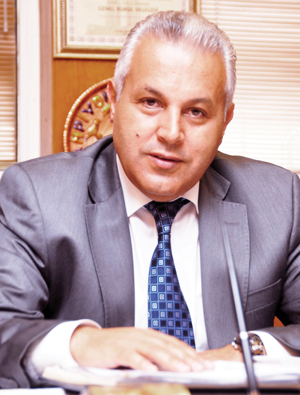
 Nihat Uysallı, President of Pasta Producers and Industrialists’ Association: “Turkish brand was one of the most valuable brands in the world. The price competition reversed this. The image of the Turkish brand is very bad. Even South Asian said that “We cannot buy this because this is Turkish pasta.” We created such a habit that customers give a price for Turkish pasta. Because of our mistakes, we cannot sell pasta to Russia. Russia imports 65-75 thousand tons of pasta from Italy. It does not buy from its neighbor.”
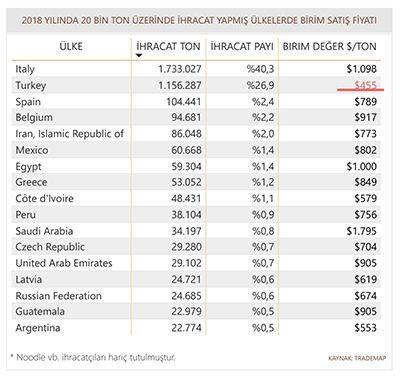
With close to 30 factories and 2.8 million tons of established capacity, Turkish Pasta sector has an important place in the world. We are in good condition both in terms of technology and quality. However, half of this established capacity is unfortunately idle. In terms of production amount, Turkish comes in third place after Italy and the United States of America while the country comes in second place after Italy in terms of export. The brutal competition within the sector hurts the country. A similar view was expressed by Nihat Uysallı, the President of Pasta Producers and Industrialists’ Association (MÜSAD), that gave an interview to BBM Magazine. He emphasized on the fact that the source of all problems lies in the excess capacity. Uysallı said that this capacity problem creates trouble for export and competition, adding that, “Unfortunately, as a country, we do not have an industry inventory. This is true for nearly all sectors. Under these circumstances, the system provides an incentive for new facilities.” He said that Italian competitors had exported the product around 1100 USD per ton in 2018 on average while Turkey’s average price was degraded to 455 USD per ton, adding that the solution is to stop contract manufacturing and to focus on branded products.
The following is the interview BBM conducted with Nihat Uysallı, the President of MÜSAD:
Dear Mr. Uysallı, you are a doyen that spent years in the pasta and wheat sector. We know you but can you introduce yourselves and the association to our readers and share your comments on Turkish Pasta Sector?
First of all, I would like to thank you. For years, I have been in the sector. Today, I act as the General Manager of Nuh’un Ankara Makarnası. Together with my duty in the professional area, I am the President of Pasta Producers and Industrialists’ Association (MÜSAD), the President of Central Anatolian Cereal, Pulse, Oilseeds and Its Products Exporter Association, and a member of the board of Ankara Chamber of Commerce. If we were to talk about the Pasta Producers and Industrialists’ Association, the association was founded in 2016. We have a new understanding and vision in this sector. Berrak Makarna, Barilla, Golda, Nuh’un Ankara, Selva and Pastavilla (Tat Gıda) got together for the development of the sector and to strengthen the image of “Turkish Pasta.” Based on Nielsen’s data, our members represent 80 percent of the market while 90 percent of brand recognition. Our members carry out 30 percent of the pasta export and 70 percent of branded product export of the pasta sector. With close to 30 factories and 2.8 million tons of established capacity, Turkish Pasta sector has an important place in the world. We are in good condition both in terms of technology and quality. In terms of production amount, Turkish comes in third place after Italy and the United States of America while the country comes in second place after Italy in terms of export. This is a huge success, but today, we are considered as the country that makes contract manufacturing. Italian competitors had exported the product around 1100 USD per ton in 2018 on average while Turkey’s average price was degraded to 455 USD per ton. From this perspective, it turns out that we export an important value just like wheat to abroad at very cheap price.
 In 2015, the export revenue was USD 417 million for 671 thousand tons while the revenue increased to USD 553 million for 1 million 208 thousand tons. Although the country increased its export, the revenue was not increased respectively. Why?
This is the result that we export many products at cheap prices. While our average price is around USD 700 per ton, it drops to USD 622 in 2015 and USD 458 in 2018. This is entirely related to internal competition. We have 2,8 million tons of established capacity but we only use 1,8 million tons of this. This is a process that started with capacity usage.
In 2015, the export revenue was USD 417 million for 671 thousand tons while the revenue increased to USD 553 million for 1 million 208 thousand tons. Although the country increased its export, the revenue was not increased respectively. Why?
This is the result that we export many products at cheap prices. While our average price is around USD 700 per ton, it drops to USD 622 in 2015 and USD 458 in 2018. This is entirely related to internal competition. We have 2,8 million tons of established capacity but we only use 1,8 million tons of this. This is a process that started with capacity usage.
WE DO NOT HAVE AN INDUSTRY INVENTORY
What do you think about half of our production capacity is idle?
We have excess established capacity. The source of all problems lies in the excess capacity. This capacity problem creates trouble for export and competition. Unfortunately, as a country, we do not have an industry inventory. This is true for nearly all sectors. Under these circumstances, the system provides an incentive for new facilities.
The sector carries out 60 percent of its export to African countries. Since Africa is rather poor region, would that cause a quality problem for the sector because of this export to African countries?
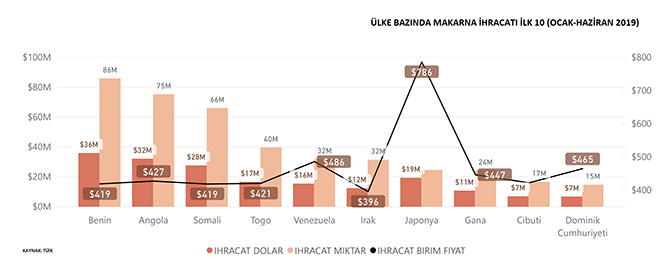
Yes. The communiqué on the use of 30 percent soft wheat for the African market was published in 2014, and we are contract manufacturing to the African market. If you look at our export performance since 2015, you can see this clearly. Our export unit price, which is 700 USD per ton, decreased continuously every year since 2015 and decreased to USD 460. In the African market, this figure falls to USD 400. It is said that Iran and Egypt are competitors to Turkey in this market, but I don’t think that that is true. This is not my claim but the figure approves this stance.
We are currently the largest exporters after Italy in quantity, and we have 26.9% of the world pasta export market, while Italy is the first with 40.3%. The share of Iran and Egypt that is considered as a rival to Turkey has 2 percent, and these countries’ production is barely enough for internal consumption. Iranian average price is USD 773 while Egypt is USD1000. That means we can increase our average to USD 550-600 easily. We have no rival in our price range.
 “WE CANNOT SELL PAST TO RUSSIA BECAUSE OF OUR MISTAKES”
Turkish brand was one of the most valuable brands in the world. The price competition reversed this. The image of the Turkish brand is very bad. Even South Asian said that “We cannot buy this because this is Turkish pasta.” We created such a habit that customers give a price for Turkish pasta. Because of our mistakes, we cannot sell pasta to Russia. Russia imports 65-75 thousand tons of pasta from Italy. It does not buy from its neighbor.
“WE CANNOT SELL PAST TO RUSSIA BECAUSE OF OUR MISTAKES”
Turkish brand was one of the most valuable brands in the world. The price competition reversed this. The image of the Turkish brand is very bad. Even South Asian said that “We cannot buy this because this is Turkish pasta.” We created such a habit that customers give a price for Turkish pasta. Because of our mistakes, we cannot sell pasta to Russia. Russia imports 65-75 thousand tons of pasta from Italy. It does not buy from its neighbor.
Additionally, Japan imports high-quality pasta in high volume. Japan is the importer in this area. We can sell our branded pasta with high-quality pasta with high prices. This case shows that we can export branded pasta when we want to.
What should we do to solve this problem?
We should not be afraid of competing with price. We should encourage and award the branded export. The product with low prices should not be supported in export. Incentives should be directed to right places and audited and measured. Otherwise, they do not work.
 “WE SELL THE CHEAPEST PASTA OF THE WORLD TO IRAQ”
Now, we have Iraqi problem on the top of all these issues. How will Iraqi ban on Turkish pasta and noddle affect the sector? What are your initiatives for this market? How do you intend to close the gap created by the Iraqi market?
Iraq’s decision reveals the importance of branded product exports. We do not consider this issue exclusively in Iraq. Brand and market diversification is vital to us. If you pay attention to branding in the products you export, you can find any other place to export; you are not affected by such situations. However, it is certain that the Iraq decision will affect the sector negatively. Iraq is the market that Turkey sells the cheapest pasta. In June 2019, the price was USD 396. Even if you sell the world’s cheapest pasta to a market, you might lose it tomorrow. So the brand is very valuable.
“WE SELL THE CHEAPEST PASTA OF THE WORLD TO IRAQ”
Now, we have Iraqi problem on the top of all these issues. How will Iraqi ban on Turkish pasta and noddle affect the sector? What are your initiatives for this market? How do you intend to close the gap created by the Iraqi market?
Iraq’s decision reveals the importance of branded product exports. We do not consider this issue exclusively in Iraq. Brand and market diversification is vital to us. If you pay attention to branding in the products you export, you can find any other place to export; you are not affected by such situations. However, it is certain that the Iraq decision will affect the sector negatively. Iraq is the market that Turkey sells the cheapest pasta. In June 2019, the price was USD 396. Even if you sell the world’s cheapest pasta to a market, you might lose it tomorrow. So the brand is very valuable.
Does the decrease in wheat cultivation areas cause difficulties in durum wheat that is the biggest raw material of pasta?
Yes, for the first time after many years, there is a big problem with durum wheat this year. The cultivation area in Turkey shrank. We see a 25 percent contraction. Because the wheat support rates are very low, farmers do not plant wheat; as a result, this year, we saw a yield drop that was far above our expectations. The Ministry revised the expectation from 3.5 million tons to 2.7 million tons of durum wheat.
AS AN INDUSTRIALIST, I WANT FARMERS TO EARN MONEY
According to this harvest, we need around 4.5 million tons of durum wheat this year. We are net importers of durum wheat this year. This was reflected in the prices. There is a terrifying price increase for the first time at the beginning of the season. TMO announced the price of 1,450 Turkish liras at the end of June. Last year, the price was 1100 Turkish liras. At the beginning of the season, it increased to 1800-1850 but decreased to around 1700 when the harvest started in Konya.
Urgently, TMO should announce the price for durum wheat because hoarders have entered into the game. We see this in prices. The pasta industrialists want the farmer to earn money. If they do not gain money, they do not plant.
How do the increases in foreign exchange rates affect pasta producers and export markets?
It can be considered that the increase in the exchange rate will positively affect the industrialists as exporters. But this is not the case. Production of durum wheat, which is our raw material, is not enough for us in our country. We import the durum wheat to export our products. The increase in foreign exchange increased raw material costs. But there has not been a similar increase in our export prices. That is because our export prices are very low. Considering that the yield in our country will be around 2.5 million tons this year, we estimate that the pasta industry will import around 1.5 million tons this year.
 How do you evaluate the efforts made to overcome the quota applied by the European Union countries to Turkish pasta?
The European Union is very big and good market in terms of price. We support the termination of quota. We tell our view to relevant authorities.
How do you evaluate the efforts made to overcome the quota applied by the European Union countries to Turkish pasta?
The European Union is very big and good market in terms of price. We support the termination of quota. We tell our view to relevant authorities.
What kind of activities do you do for the development of the sector and the recognition of the image of Turkish pasta?
For this purpose, we established MÜSAD whose primary objective is the development of the sector and the increase in the image of Turkish Pasta. We carry out our work under the roof of our association.
This is a very important issue for us. Of course, our association is very young and we have just started working. Besides, it’s not something we can do alone. But the association is ready to do its part. We can accomplish this by working together with the public, industry, producers, NGOs, and universities. To realize this, we continue to communicate with our shareholders.
First of all, we should analyze our current situation well from past to present and objectively demonstrate our advantages and disadvantages. We should base this on data and scientific base. For this, we started to compile a monthly report. We deliver this report to decision-makers every month regularly. This report presents the latest situation on export, import, and production of our sector in the country and the world.
Additionally, we will have an analysis study on foreign markets. We continue working on this issue. Also, the wheat is very important issue for us. In recent years, we have seen that our farmers have shunned from wheat planting, and the cultivation areas have shrunk. We have been working on this. There will be works on increasing the seed quality and wheat efficiency. We will have communications.
When you evaluate the technology used by Turkish pasta producers, what is your situation compared to your competitors?
Currently, when we look at the facilities installed in our country, most of our facilities have no problem with technology. We have good standing in terms of installed capacity and technology compared to competing countries. We have even more capacity.
As Turkish pasta sector, can you monitor new trends in the global pasta markets?
As a sector, we export to 160 countries. Therefore, we follow the trends in global markets. However, companies do this with their own brand understanding. While selling pasta for 460 dollars in the world, 80 percent of it is contracted, it is not possible to apply and develop new trends. Theoretically possible but not actually possible.
Our society considers pasta that causes gain weight and has adverse effect on healthy. This image hurts the sector. As an association, what do you do to inform consumers to increase the pasta consumption?
Yes, unfortunately, there are such misconceptions in our country especially with the comments of some people that are not experts in the subject. Per capita consumption data shows this. Our country is in the second place in pasta export, when you look at per capita consumption, it stays behind. In Italy, per capita pasta consumption is 23.5 kg, while this figure is only 7.3 kg in our country. Our members represent 80 percent of the internal market. So, this is very important topic for us. As an association, we have initiatives to promote the pasta in correct way under the World Pasta Day. But these efforts are not enough. We are working to increase these efforts.